Idaho DMV Practice Test 10
Practice test 10 of 10: 40 questions in the Idaho knowledge test format, from the official handbook. Free, with explanations in 5 languages.
Loading questions…
Questions and answers in this test (40)
Open the list after you finish the test, or use it to review.
Your blood alcohol concentration (BAC) depends mainly on how much you drink, how fast you drink, and:
Answer: Your body weight
BAC is the amount of alcohol in your blood. It depends on how much you drink, how quickly you drink and how much you weigh.
When should you NOT wear sunglasses while driving?
Answer: At night
Tinted lenses cut the light you need to see at night and on dark days.
When should you adjust your seat and mirrors?
Answer: Before you start driving
Adjust them before you drive; in traffic you will not have time to do it safely.
On a wet road, a large truck is about to pass you. What should you be ready for?
Answer: Spray from the truck may make it hard to see
Water thrown up by a large truck's wheels can cover your windshield. Have your wipers on before it passes.
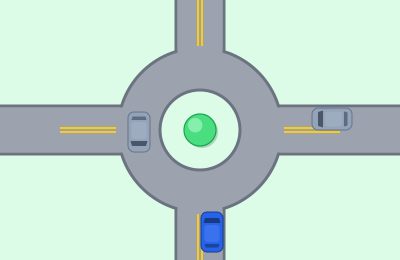
When you enter or leave a roundabout, you must yield to:
Answer: Pedestrians and bicyclists crossing
Watch for and yield to pedestrians and bicyclists at the crosswalks as you enter and exit a roundabout.
When you drive out of a driveway or parking lot onto a road, you must:
Answer: Stop and yield to traffic and pedestrians
Coming out of a driveway, alley or private road, stop and yield to pedestrians and to traffic on the road.
Why is carbon monoxide from a car's exhaust so dangerous?
Answer: You cannot see or smell it, and it can kill
Carbon monoxide is an odorless, colorless gas; a leaky exhaust can let it into the car.
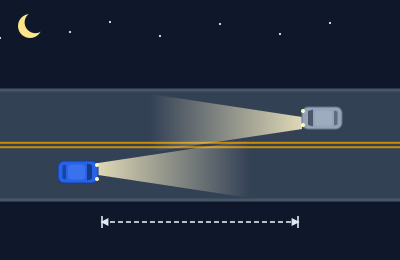
In Idaho, you must dim your high beams when an oncoming vehicle is within:
Answer: 500 feet
Idaho: switch to low beams within 500 feet of an oncoming vehicle.
You are stopped behind a large truck on an uphill road. You should:
Answer: Leave extra space in case the truck rolls back
A large truck or bus may roll back a little when it starts to move on a hill. Leave room in front of your car.
In a work zone, the directions given by a flagger:
Answer: Must be followed
Flaggers control traffic in work zones. You must obey their signals.
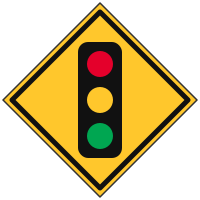
A yellow diamond sign showing a traffic light means:
Answer: Traffic signal ahead
A traffic signal is ahead. Be ready to stop.
On public roads, horseback riders and horse-drawn vehicles:
Answer: Have the same rights and duties as drivers
People riding or driving horses on public roads have the same rights as drivers and must follow the same rules of the road.
Under the "implied consent" law, by driving on public roads you have agreed to:
Answer: Take a chemical test for alcohol when a police officer lawfully asks
Implied consent means that by driving, you have already agreed to take a breath or blood test for alcohol when a police officer lawfully asks.
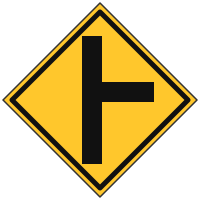
A yellow diamond sign showing a vertical line with a short line joining from the right means:
Answer: Side road enters from the right ahead
A side road joins from the right; watch for vehicles entering.
Which is a safe speed habit?
Answer: Keep a steady speed with the flow of traffic
Keep a steady speed. Bursts of speed and sudden braking confuse other drivers and are dangerous.
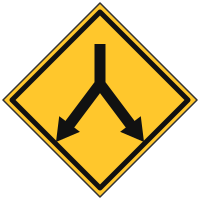
A yellow diamond sign with arrows pointing down to the left and down to the right means:
Answer: Traffic may pass on either side of the obstacle
You may go around the island or obstruction on either side.
Distracted driving is any activity that:
Answer: Takes your eyes, hands or mind away from driving
Anything that takes your eyes off the road, hands off the wheel or mind off driving is a distraction.
Why should you reduce your speed in heavy traffic?
Answer: You have less space and time to react
In heavy traffic there is less space around you, so slowing down gives you time to react.
You are leaving a freeway. Where should you start to slow down?
Answer: After you move into the deceleration (exit) lane
Keep up with traffic on the freeway. Slow down only after you are in the deceleration lane or on the exit ramp.
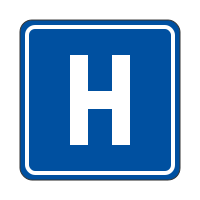
Blue signs with white letters or symbols show:
Answer: Services such as gas, food and hospitals
Blue service signs point to rest areas, gas stations, camping and medical facilities.
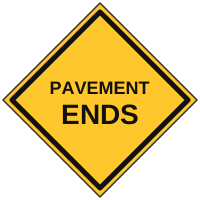
What does the yellow diamond sign 'PAVEMENT ENDS' tell you?
Answer: The paved road changes to an unpaved surface
It warns that paved surface ends and gravel or dirt begins, so slow down and expect less traction.
Why is speeding toward a work zone especially dangerous?
Answer: You may suddenly come upon slowed or stopped traffic
Work zones often cause traffic to slow or stop, sometimes out of sight around a curve or over a hill. If you are speeding, you may not stop in time.
You are waiting to turn left. An oncoming car has its right turn signal on. You should:
Answer: Wait until you are sure the car is really turning
Do not rely on another driver's turn signal. The driver may turn later or may have forgotten to cancel the signal.
An ambulance with flashing lights and a siren is coming. You should:
Answer: Pull over to the right edge of the road and stop
Pull to the right and stop. If you are in an intersection, drive out of it first. Do this even if the vehicle is in the opposite lane.
As a driver drinks more alcohol, the driver usually:
Answer: Becomes less aware of being impaired
Alcohol can make you feel overconfident. By the time you feel its effects, your judgment and coordination are already impaired.
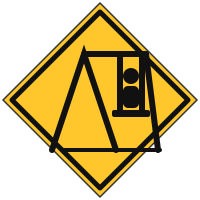
This sign means:
Answer: Playground area, children nearby
The swing symbol marks a playground area where many children require caution.
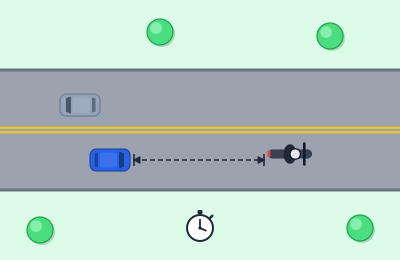
Why should you not follow a motorcycle too closely?
Answer: A motorcycle can stop in a shorter distance than a car
A motorcycle can often stop more quickly than a car. Keep a safe following distance so you can stop in time.
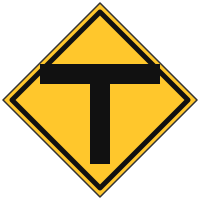
A yellow diamond sign shaped like the letter T means:
Answer: The road ends ahead; you must turn left or right
The road you are on ends at a T intersection; prepare to turn.
After drinking alcohol, a cup of black coffee or a cold shower will:
Answer: Make you more awake, but not sober
Coffee, cold showers or fresh air may make you feel more awake, but they do not remove alcohol. Only time sobers you up.
Trees and buildings block your view of the side streets at an intersection ahead. You should:
Answer: Slow down so you can stop if a car pulls out
Approach an intersection with a blocked view slowly enough to stop if another vehicle suddenly pulls out.
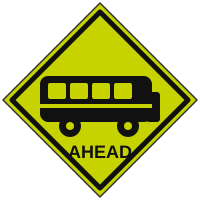
A yellow-green diamond sign with a school bus symbol means:
Answer: A school bus stop is ahead
The sign warns that a school bus stops ahead to pick up or drop off children.
In Idaho, after you move, you must report your new address to the licensing agency within:
Answer: 30 days
Idaho: report an address change within 30 days.
Alcohol makes it harder for a driver to:
Answer: Judge distances and speeds of other vehicles
Alcohol affects your vision. You will have trouble judging how far away other vehicles are and how fast they are moving.
How can marijuana affect a driver?
Answer: It makes it harder to judge time and distance
Marijuana impairs driving. It can cause drowsiness, make it hard to judge time and distance, and make it hard to stay in your lane.
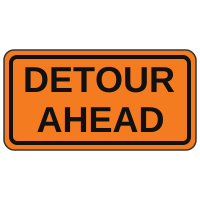
Why are detour signs posted?
Answer: To guide you around a closed road or work zone
Detour signs lead traffic around a closure and back to the original road.
Because of the air bag, how should the driver sit?
Answer: Well back from the steering wheel
An air bag inflates with great force; sitting well back from the wheel lowers the risk of injury from it.
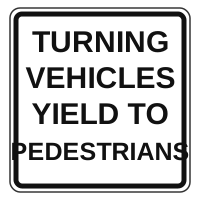
You are turning left on a green light and people are in the crosswalk. You must:
Answer: Stop and let them finish crossing
A pedestrian in a crosswalk has the right of way, so a turning driver stops until the crosswalk is clear.
In Idaho, if you fail the knowledge test, you must wait how long before retesting?
Answer: 3 days
Wait three days to retest (the same for the skills test).
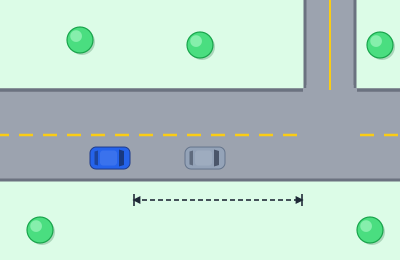
In Idaho, you may not pass another vehicle within how many feet of an intersection, bridge, tunnel or railroad crossing?
Answer: 100 feet
Idaho: do not pass within 100 feet of an intersection, bridge, tunnel or railroad crossing.
Your car breaks down on the highway. You should:
Answer: Pull as far off the road as possible and turn on your flashers
Get the vehicle off the road, away from traffic, and turn on the emergency flashers so others can see it.
About this test
Questions come from the Idaho Driver's Manual (2026) and from rules that apply in every state. Each answer shows its source.
More Idaho tests
Group 1
Start here
Full practice tests in the format of the real Idaho knowledge test. Questions do not repeat between tests.
Group 2
Road signs
Shapes, colors and meanings of the signs on the test.
Group 3
Rules of the road
Right of way, turns, parking and sharing the road.
Group 4
Safe driving
Night, weather, emergencies, alcohol and what to do after a crash.
Group 5
Idaho laws
Rules that are specific to Idaho.
Group 6
Final exam prep
Check that you are ready before test day.