New Hampshire DMV Practice Test 10
Practice test 10 of 10: 40 questions in the New Hampshire knowledge test format, from the official handbook. Free, with explanations in 5 languages.
Loading questions…
Questions and answers in this test (40)
Open the list after you finish the test, or use it to review.
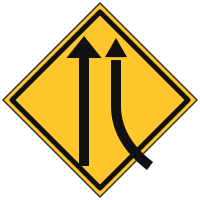
A yellow diamond sign showing two arrows side by side, the right one curving in from the side, means:
Answer: Added lane — traffic enters in its own lane, no merge needed
Entering traffic gets its own lane; it does not have to merge.
Which of these conditions can make the posted speed limit too fast to be safe?
Answer: Poor visibility from fog or heavy rain
Your speed must fit the conditions, including how far ahead you can see. Fog, heavy rain or darkness can make the posted limit unsafe.
When driving near schools and playgrounds, you should:
Answer: Slow down and watch for children
Children are hard to see and may run into the street without warning. Slow down near schools and playgrounds.
On a two-lane road, where is passing NOT allowed even if the center line is broken?
Answer: At or near an intersection or railroad crossing
Do not pass at or close to intersections or railroad crossings. Vehicles may cross or turn into your path there.
On public roads, horseback riders and horse-drawn vehicles:
Answer: Have the same rights and duties as drivers
People riding or driving horses on public roads have the same rights as drivers and must follow the same rules of the road.
You are in a crash in which a person is injured. You must:
Answer: Notify the police right away
A crash with injuries must be reported to the police right away. Call 911 so police and an ambulance can come.
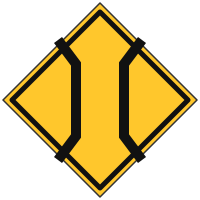
A yellow diamond sign with two parallel lines that flare outward at both ends means:
Answer: Narrow bridge ahead
A bridge ahead is narrower than the road; slow down and watch for oncoming traffic.
In New Hampshire, unless otherwise posted, the maximum speed limit in a rural residence district is:
Answer: 35 mph
Rural residence district: 35 mph; business or urban residence district: 30 mph.
Your car has air bags. Should you still wear a seat belt?
Answer: Yes, air bags work together with seat belts
Air bags are a supplement to seat belts, not a replacement; always buckle up.
A space cushion means keeping open space:
Answer: In front, behind and on the sides of your vehicle
Open space all around your vehicle gives you time and room to react to other drivers' mistakes.
In New Hampshire, by driving on public roads you have agreed to:
Answer: Take a chemical test for alcohol or drugs if lawfully asked
New Hampshire has an implied consent law: refusing a lawful chemical test leads to license suspension.
If you refuse a chemical test for alcohol after a lawful DUI arrest, you will:
Answer: Lose your driving privilege (license suspension or revocation)
Refusing a chemical test under implied consent leads to suspension or revocation of your license, even before any court case. The length and other penalties depend on state law.
Within the speed limit, which speed is generally safest?
Answer: About the same speed as other traffic
Crashes are more likely when one driver goes faster or slower than others. Up to the limit, keep pace with the flow of traffic.
In New Hampshire, how far should a driver sit from the steering-wheel airbag cover?
Answer: 10 inches
New Hampshire: sit at least 10 inches from the airbag cover (center of the wheel to your breastbone).
What is hydroplaning?
Answer: Tires riding on a layer of water and losing contact with the road
When hydroplaning, the tires ride up on water like water skis, so you can lose the ability to steer and brake.
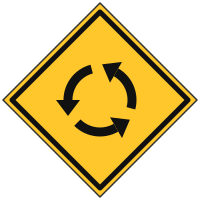
You are entering a roundabout. You should:
Answer: Slow down and yield to traffic already in the circle
Entering traffic yields to vehicles already circulating, so slow down and enter only when there is a safe gap.
You are driving through a neighborhood with cars parked along the street. Why should you be ready to stop quickly?
Answer: Children may run out from between parked vehicles
In residential areas and near playgrounds, children can dart into the street from between parked cars. Drive slowly and be ready to stop.
When you approach a stop sign, you must:
Answer: Come to a complete stop
A stop sign always requires a complete stop at the stop line, crosswalk or before the intersection.
Compared with dry pavement, on a wet road your car will:
Answer: Need a longer distance to stop
Wet roads are slippery: it takes longer to stop and it is harder to turn. Reduce your speed.
A police officer directing traffic signals you to go through a red light. You should:
Answer: Follow the officer's direction
An officer's directions override signs, signals and pavement markings.
After a crash, drivers involved should exchange:
Answer: Names, addresses and vehicle and insurance details
Drivers in a crash should exchange names, addresses, driver license, plate or registration numbers and insurance information.
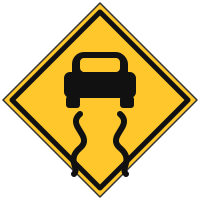
A yellow diamond sign showing a car with wavy skid marks behind it means:
Answer: Slippery when wet
The road surface becomes slippery when wet. Slow down and avoid sudden braking or turns.
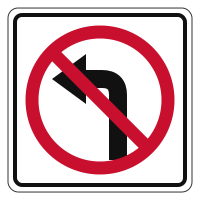
A red circle with a slash over a symbol means:
Answer: The action shown is not allowed
The red circle and slash prohibit the action shown, for example NO LEFT TURN or NO U-TURN.
When stopping a vehicle, "reaction time" is the time it takes to:
Answer: Move your foot to the brake and begin braking
Reaction time is the time between deciding to stop and starting to brake, while your foot moves from the gas to the brake.
A car in the next lane has stopped at a crosswalk. You should:
Answer: Stop too — a pedestrian may be crossing
Never pass a vehicle stopped at a crosswalk. It may be stopped for a pedestrian you cannot see.
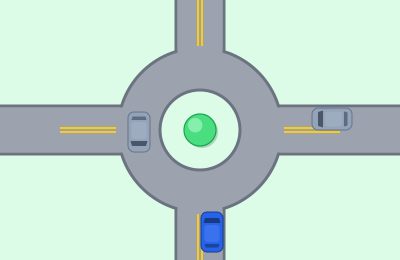
What should you do as you approach a roundabout?
Answer: Slow down and be ready to yield
Slow down as you approach a roundabout and yield to traffic already in it.
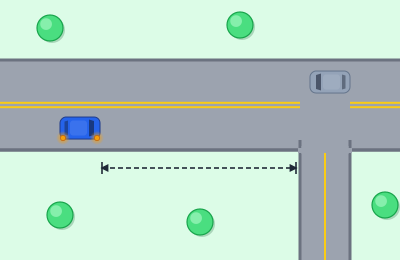
In New Hampshire, you must signal at least how far before you turn or change lanes?
Answer: 100 feet
New Hampshire: signal at least 100 feet before you turn or change lanes.
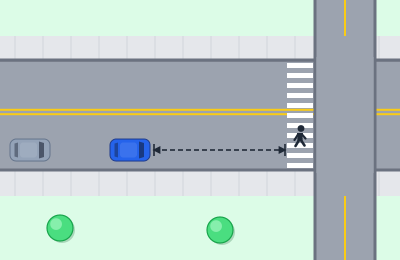
In New Hampshire, you may not park within how many feet of a crosswalk at an intersection?
Answer: 20 feet
New Hampshire: do not park within 20 feet of a crosswalk at an intersection.
How is a shared center left-turn lane usually marked?
Answer: A solid yellow line on the outside and a broken yellow line on the inside, on each side
A two-way left-turn lane has a solid yellow line next to the through lanes and a broken yellow line on the inside, on both sides.
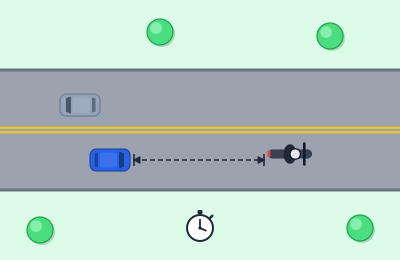
Why should you not follow a motorcycle too closely?
Answer: A motorcycle can stop in a shorter distance than a car
A motorcycle can often stop more quickly than a car. Keep a safe following distance so you can stop in time.
Compared with a car, the speed and distance of an approaching motorcycle are:
Answer: Harder to judge, so look carefully
Motorcycles are small and hard to see, and drivers often misjudge how fast and how far away they are. Take extra care.
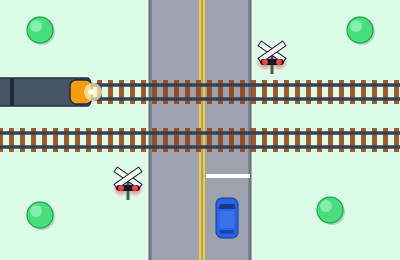
A train is coming toward a crossing you are approaching. You should:
Answer: Stop and wait for the train to pass
Never try to beat a train to a crossing. Stop and wait until it has passed.
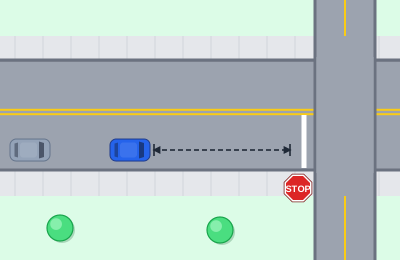
In New Hampshire, you may not park within how many feet of a STOP sign?
Answer: 30 feet
New Hampshire: do not park within 30 feet of a STOP sign.
On the highway in New Hampshire, drivers should signal at least how far before changing lanes or exiting the roadway?
Answer: 500 feet
At least 500 feet on the highway; at least 100 feet before a turn.
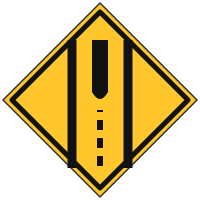
A yellow diamond sign showing a median (island) beginning ahead in the middle of the road means:
Answer: Divided highway begins — keep right
The road ahead becomes divided by a median; stay to the right.
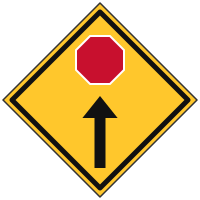
A yellow diamond sign showing a red octagon and an arrow means:
Answer: Stop sign ahead — be ready to stop
A stop sign is ahead, possibly hidden by a curve or hill.
When you enter a roundabout, you must yield to:
Answer: Traffic already in the roundabout
Drivers entering a roundabout or traffic circle yield to vehicles already in the circle.
In a work zone, when may you return to normal driving?
Answer: After you pass the "End Road Work" sign
Keep obeying work zone signs and speeds until you pass the "End Road Work" sign.
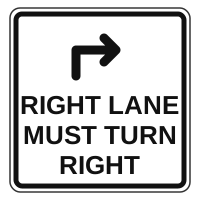
You are in the right lane at an intersection with this sign, but you want to go straight. What must you do?
Answer: Change lanes before the intersection
A right lane marked this way must turn right, so go straight only from another lane.
If a tire blows out while you are driving, you should:
Answer: Hold the wheel tightly and slowly ease off the gas
After a blowout, hold the steering wheel firmly, ease off the gas and brake gently once the car is under control.
About this test
Questions come from the New Hampshire Driver's Manual and from rules that apply in every state. Each answer shows its source.
More New Hampshire tests
Group 1
Start here
Full practice tests in the format of the real New Hampshire knowledge test. Questions do not repeat between tests.
Group 2
Road signs
Shapes, colors and meanings of the signs on the test.
Group 3
Rules of the road
Right of way, turns, parking and sharing the road.
Group 4
Safe driving
Night, weather, emergencies, alcohol and what to do after a crash.
Group 5
New Hampshire laws
Rules that are specific to New Hampshire.
Group 6
Final exam prep
Check that you are ready before test day.