Wisconsin DMV Practice Test 8
Practice test 8 of 8: 50 questions in the Wisconsin knowledge test format, from the official handbook. Free, with explanations in 5 languages.
Loading questions…
Questions and answers in this test (50)
Open the list after you finish the test, or use it to review.
When you make a turn, your rear wheels:
Answer: Travel inside the path of the front wheels
Rear wheels track inside the front wheels, so leave room at the curb and watch for pedestrians and bicyclists.
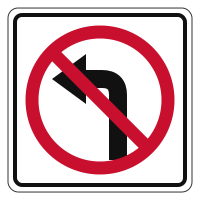
A red circle with a slash over a symbol means:
Answer: The action shown is not allowed
The red circle and slash prohibit the action shown, for example NO LEFT TURN or NO U-TURN.
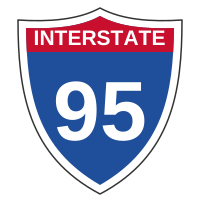
This sign means:
Answer: An Interstate highway route
The red and blue shield with the legend INTERSTATE marks a route of the Interstate Highway System.
Your brakes have failed and you use the parking brake. Why should you be ready to release it?
Answer: The rear wheels may lock and the car may skid
Apply the parking brake slowly and be ready to let it off if the rear wheels lock and the car starts to skid.
Your speed should always be slow enough that you can:
Answer: Stop within the distance you can clearly see ahead
Choose a speed that lets you stop within the clear distance you can see ahead. If you cannot, you are driving too fast.
Your car begins to skid. What should you do with the gas pedal?
Answer: Ease off it
Taking your foot off the gas helps the tires regain grip; the skid may stop right away.
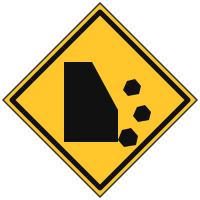
When you see a Fallen Rocks sign, you should mainly watch:
Answer: The hillside, for rocks about to fall
The sign warns of rocks that may already be in the road, so keep your eyes on the pavement ahead.
You reach an intersection and another vehicle is already in it. You should:
Answer: Yield to the vehicle already in the intersection
Always yield to vehicles (and pedestrians) that are already in the intersection.
When you must stop at an intersection with a white stop line, you should stop:
Answer: Before the stop line
Stop before the stop line; if there is none, before the crosswalk; if neither, before entering the intersection.
On an Interstate route marker like this, an odd route number such as 95 generally means the highway runs:
Answer: North and south
Odd Interstate numbers run north-south and even numbers run east-west.
A motorcycle is in your lane ahead. You should:
Answer: Give it the full lane, as you would a car
A motorcycle is entitled to the full width of a lane. Never share its lane.
How do you know which lane to use in a multi-lane roundabout?
Answer: Check the signs and pavement markings before you enter
Signs and pavement markings before a multi-lane roundabout show which lane to use for your exit. Choose it before entering.
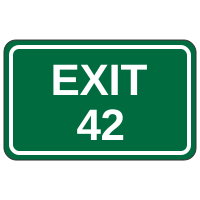
You see a green sign like this, but you miss your exit. What should you do?
Answer: Continue to the next exit and return from there
Never stop, back up or turn around on a highway; take the next exit and come back.
At an intersection without painted crosswalk lines, a pedestrian starts to cross. You must:
Answer: Yield — there is an unmarked crosswalk at intersections
Drivers must yield to pedestrians in marked or unmarked crosswalks.
In Wisconsin, a crash must be reported if damage to government property (signs, guard rails) is at least:
Answer: $200
Government property damage of $200 or more; other property damage of $1,000 or more.
Why should you avoid honking your horn close to a bicyclist unless there is danger?
Answer: The sudden noise may startle the rider and cause a loss of control
A loud horn close by can scare a bicyclist and make them swerve or fall. Use the horn near bicyclists only to prevent a crash.
A yellow arrow after a green arrow means:
Answer: The protected turn is ending; be ready to stop
A yellow arrow means the protection of the green arrow is about to end.
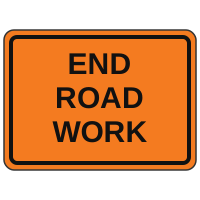
Until when should you follow work zone rules and speed limits?
Answer: Until you see "End Road Work"
Observe the posted signs until the End Road Work sign appears.
How do you check that you are using the "two-second rule"?
Answer: When the car ahead passes a fixed object, count — you should not reach it before "one thousand two"
Pick a fixed object; when the vehicle ahead passes it, count. If you reach it before two seconds, you are too close.
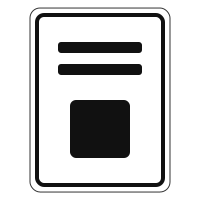
White rectangular signs with black letters or symbols are usually:
Answer: Regulation signs
White rectangles give rules you must obey, such as speed limits and turn restrictions.
On a two-lane, two-way road, on which side should you normally pass another vehicle?
Answer: On the left
Passing is normally done on the left. Passing on the right is dangerous because other drivers do not expect it.
When driving near schools and playgrounds, you should:
Answer: Slow down and watch for children
Children are hard to see and may run into the street without warning. Slow down near schools and playgrounds.
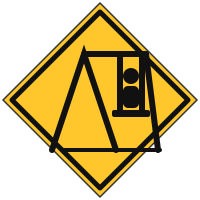
When you see a playground warning sign, you should:
Answer: Slow down and watch for children
Children often run into the street near playgrounds, so slow down and stay alert.
Because of the air bag, how should the driver sit?
Answer: Well back from the steering wheel
An air bag inflates with great force; sitting well back from the wheel lowers the risk of injury from it.
Before you pull out to pass on a two-lane road, you must be sure that:
Answer: You can return to your lane before meeting oncoming traffic
Only pass if you can see far enough ahead and get back into your lane before oncoming traffic arrives or a no-passing zone begins.
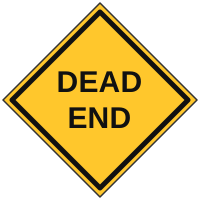
This sign means:
Answer: The road ahead has no through route
Dead End warns that the road does not continue, so there is no way through.
In Wisconsin, a new resident should apply for a Wisconsin driver license within how many days after moving?
Answer: 60 days
New residents should apply within 60 days after moving.
Where should you mainly look while driving?
Answer: Well ahead, up the road
Looking well ahead gives you time to see problems and react, and helps you keep a steady path.
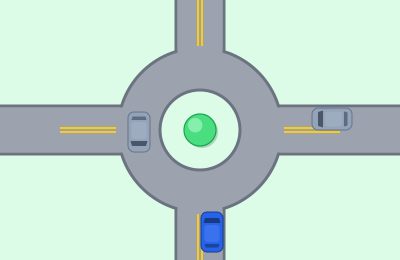
When you enter or leave a roundabout, you must yield to:
Answer: Pedestrians and bicyclists crossing
Watch for and yield to pedestrians and bicyclists at the crosswalks as you enter and exit a roundabout.
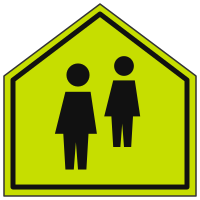
A five-sided (pentagon) yellow or fluorescent yellow-green sign warns of:
Answer: A school zone or school crossing
The pentagon shape is used for school zone and school crossing signs.
After a crash, drivers involved should exchange:
Answer: Names, addresses and vehicle and insurance details
Drivers in a crash should exchange names, addresses, driver license, plate or registration numbers and insurance information.
In Wisconsin, children who outgrow a car seat must use a booster seat until at least what age (unless they are tall enough for the seat belt)?
Answer: 8 years old
Wisconsin: booster seat until at least 8 years old, or until the child fits the adult belt as the law describes.
A car is coming toward you in your lane. You should:
Answer: Slow down, sound your horn and move to the right
Move right, even onto the shoulder; do not go left, because the other driver may swerve back into that lane.
You just had a heated argument and feel very angry. Before driving, you should:
Answer: Take time to calm down first
Strong emotions such as anger affect your judgment. Calm down before you drive, or let someone else drive.
Flaggers in work zones usually wear orange vests and direct traffic with:
Answer: STOP/SLOW paddles or red flags
Flaggers use STOP/SLOW paddles or red flags to stop, slow or guide traffic through a work zone.
What is a reversible lane?
Answer: A lane where the direction of traffic changes at certain times
Reversible lanes carry traffic one way at some times (often rush hour) and the opposite way at other times. Check the signals before using one.
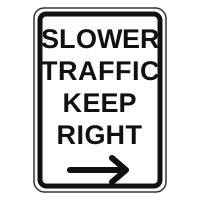
On a multilane highway, where should slower traffic drive?
Answer: In the right lane, except to pass
Slower traffic stays in the right lane; the left lane is for passing.
When stopping a vehicle, "perception time" is the time it takes to:
Answer: Recognize that you need to stop
Perception time is how long it takes you to see a danger and realize you must stop. Only then can you react.
A car ahead of you weaves back and forth, drives unusually slowly and stops for no reason. This driver:
Answer: May be impaired by alcohol or drugs
Weaving, driving too fast or too slow, wide turns and sudden stops are common signs of an impaired driver. Keep a safe distance.
Another vehicle is passing you on the left. You should:
Answer: Stay in your lane and slow down slightly
Keep to your lane and ease off the gas slightly so the other driver can complete the pass.
Two cars reach an intersection with no signs or signals at the same time. Who must yield?
Answer: The driver on the left
When two vehicles arrive at the same time, the driver on the left yields to the driver on the right.
White lane lines separate:
Answer: Lanes of traffic moving in the same direction
White lines separate lanes going the same direction; yellow lines separate opposite directions.
In Wisconsin, a driver with a probationary license may use a phone while driving:
Answer: Only to report an emergency
Probationary drivers may use a phone only to report an emergency.
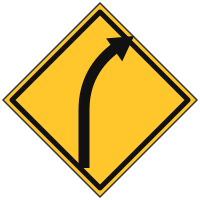
A yellow diamond sign with an arrow that bends to the right means:
Answer: Curve to the right ahead
The road curves to the right ahead; slow down before the curve.
Compared with a light car at the same speed, a heavier vehicle:
Answer: May need a longer distance to stop
Vehicle weight affects stopping distance. Heavier vehicles may take longer to stop, so give them more room.
Can a driver be convicted of driving under the influence without an alcohol test result?
Answer: Yes, based on the officer's observations
What the officer sees, such as how you drive and behave, is also evidence. You can be convicted of DUI even without a test result.
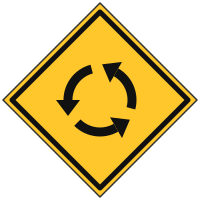
You are entering a roundabout. You should:
Answer: Slow down and yield to traffic already in the circle
Entering traffic yields to vehicles already circulating, so slow down and enter only when there is a safe gap.
How do you begin a three-point turn (K-turn)?
Answer: From the right edge, drive forward slowly while turning the wheel sharply left
Start a three-point turn at the right edge of the road. Check traffic, then move forward slowly while turning the wheel to the left.
Why is carbon monoxide from a car's exhaust so dangerous?
Answer: You cannot see or smell it, and it can kill
Carbon monoxide is an odorless, colorless gas; a leaky exhaust can let it into the car.
How should the lap part of a seat belt be worn?
Answer: Low and snug across the hips
A lap belt worn low across the hip bones holds you safely; worn over the stomach it can cause internal injuries.
About this test
Questions come from the Wisconsin Motorists' Handbook (2026) and from rules that apply in every state. Each answer shows its source.
More Wisconsin tests
Group 1
Start here
Full practice tests in the format of the real Wisconsin knowledge test. Questions do not repeat between tests.
Group 2
Road signs
Shapes, colors and meanings of the signs on the test.
Group 3
Rules of the road
Right of way, turns, parking and sharing the road.
Group 4
Safe driving
Night, weather, emergencies, alcohol and what to do after a crash.
Group 5
Wisconsin laws
Rules that are specific to Wisconsin.
Group 6
Final exam prep
Check that you are ready before test day.