New Jersey DMV Practice Test 8
Practice test 8 of 9: 50 questions in the New Jersey knowledge test format, from the official handbook. Free, with explanations in 5 languages.
Loading questions…
Questions and answers in this test (50)
Open the list after you finish the test, or use it to review.
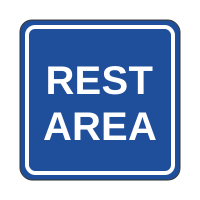
This sign means:
Answer: A rest area is ahead
A blue REST AREA sign shows a safe place to stop off the highway.
Another driver cuts in front of you rudely. The best response is to:
Answer: Stay calm and let it go
Do not get angry when others make mistakes or act rude. Be patient and courteous, and keep your attention on driving.
You need to make a phone call while driving. The safest choice is to:
Answer: Pull over in a safe place before making the call
Phone calls take your attention from driving; the safest choice is to stop in a safe place first.
You have the right of way, but another driver starts to go anyway. You should:
Answer: Let the other driver go to avoid a crash
Right of way is given, not taken. If another driver does not yield, let them go to avoid a crash.
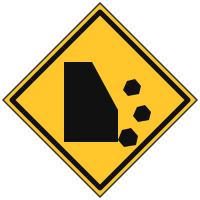
This sign warns that:
Answer: Rocks may be in the roadway
Fallen Rocks warns of rocks that may be lying in the road, so watch the pavement.
What is hydroplaning?
Answer: Tires riding on a layer of water and losing contact with the road
When hydroplaning, the tires ride up on water like water skis, so you can lose the ability to steer and brake.
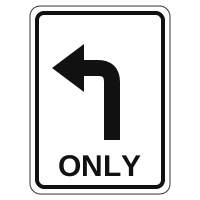
A white sign over a lane showing a left-turn arrow and the word ONLY means:
Answer: Vehicles in this lane must turn left
Drivers in that lane must turn left.
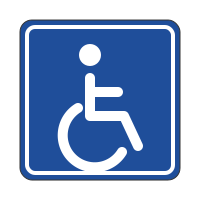
A parking space has this blue sign. Who may park there?
Answer: Vehicles with a disability permit
Spaces with this sign are reserved for vehicles with disability plates or permits.
In New Jersey, a driver under 21 violates the law starting at what BAC?
Answer: 0.01%
New Jersey: for drivers under 21 the limit is 0.01%.
Where should you mainly look while driving?
Answer: Well ahead, up the road
Looking well ahead gives you time to see problems and react, and helps you keep a steady path.
Alcohol makes it harder for a driver to:
Answer: Judge distances and speeds of other vehicles
Alcohol affects your vision. You will have trouble judging how far away other vehicles are and how fast they are moving.
You are waiting to turn left. An oncoming car has its right turn signal on. You should:
Answer: Wait until you are sure the car is really turning
Do not rely on another driver's turn signal. The driver may turn later or may have forgotten to cancel the signal.
In New Jersey, what amount of property damage makes a crash one that must be reported?
Answer: $500
New Jersey: the property-damage threshold for reporting a crash is $500 (see the handbook for who receives the report).
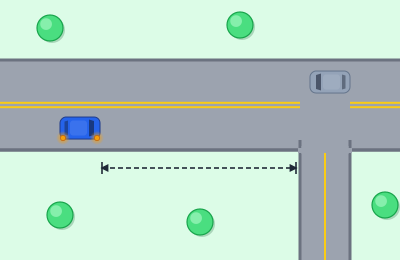
In New Jersey, you must signal at least how far before you turn?
Answer: 100 feet
New Jersey: signal at least 100 feet before turning.
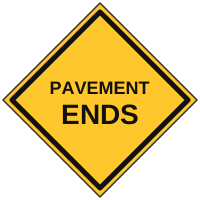
What does the yellow diamond sign 'PAVEMENT ENDS' tell you?
Answer: The paved road changes to an unpaved surface
It warns that paved surface ends and gravel or dirt begins, so slow down and expect less traction.
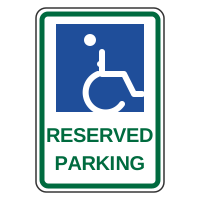
Who may park in a space marked with this sign?
Answer: Only vehicles with a disability permit
The blue wheelchair symbol reserves the space for vehicles with a disabled-parking permit or special plate.
After drinking alcohol, a cup of black coffee or a cold shower will:
Answer: Make you more awake, but not sober
Coffee, cold showers or fresh air may make you feel more awake, but they do not remove alcohol. Only time sobers you up.
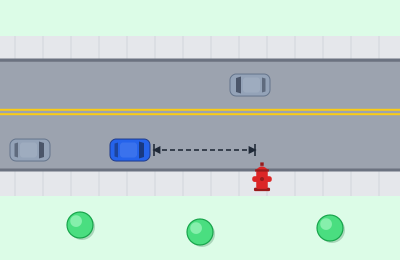
In New Jersey, you may not park within how many feet of a fire hydrant?
Answer: 10 feet
New Jersey: do not park within 10 feet of a fire hydrant.
What is the best way to avoid being tired on a long drive?
Answer: Get plenty of sleep before the trip
Rest is the real cure for fatigue; get enough sleep before you drive.
How does your speed affect your stopping distance?
Answer: The faster you go, the longer the distance to stop
The faster you are going, the more time and distance you need to stop.
After a crash, a person is injured but not in danger from fire or traffic. You should:
Answer: Not move them, and call for help
Do not move an injured person unless there is fire or other life-threatening danger.
On a two-lane, two-way road, on which side should you normally pass another vehicle?
Answer: On the left
Passing is normally done on the left. Passing on the right is dangerous because other drivers do not expect it.
In New Jersey, at first a provisional (teen) driver may carry how many passengers under 21 who are not family members, unless an adult supervisor is present?
Answer: 1
New Jersey: no more than 1 non-family passenger(s) under 21 at first, unless supervised.
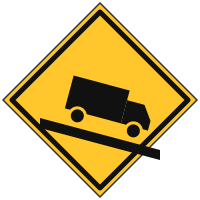
This sign warns of:
Answer: A steep downgrade ahead
The truck on a slope warns of a steep hill: slow down and be ready to shift to a lower gear.
At higher speeds, you have:
Answer: Less time to spot and react to hazards
The faster you drive, the less time you have to see a hazard and react to it.
In New Jersey, you should not pass other vehicles within how many feet of a railroad crossing?
Answer: 100 feet
Do not pass other vehicles within 100 feet of a railroad crossing.
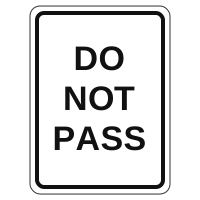
A white sign reading DO NOT PASS means:
Answer: You may not pass other vehicles on this stretch of road
Passing is not allowed where this sign is posted.
You are stopped behind a large truck on an uphill road. You should:
Answer: Leave extra space in case the truck rolls back
A large truck or bus may roll back a little when it starts to move on a hill. Leave room in front of your car.
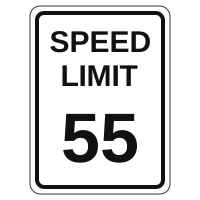
A white sign reading SPEED LIMIT 55 means:
Answer: 55 mph is the maximum legal speed under ideal conditions
It is the highest legal speed in good conditions; slow down for rain, traffic or darkness.
In New Jersey, an ignition interlock device prevents the vehicle from starting if the driver's BAC exceeds:
Answer: 0.05%
The device has a built-in breathalyzer and prevents the vehicle from starting if the motorist's BAC exceeds 0.05%.
On a two-lane road, you should never pass:
Answer: When approaching a curve or the top of a hill
Never pass where you cannot see oncoming traffic, such as near curves or hilltops.
Why should you reduce your speed in heavy traffic?
Answer: You have less space and time to react
In heavy traffic there is less space around you, so slowing down gives you time to react.
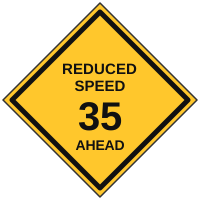
When does the new, lower speed limit begin after a Reduced Speed Ahead sign?
Answer: At the next speed limit sign
The warning sign only gives notice; the new limit starts at the next speed limit sign.
You are entering a freeway from an on-ramp. You should:
Answer: Speed up to traffic speed and merge into a safe gap
Use the on-ramp and acceleration lane to match the speed of traffic, then merge into a safe gap; drivers already on the freeway have the right-of-way.
After a crash, electrical wires are down and touching your car. You should:
Answer: Stay inside the vehicle until help arrives
Stay inside and warn others to stay away until help arrives.
If you refuse a chemical test for alcohol after a lawful DUI arrest, you will:
Answer: Lose your driving privilege (license suspension or revocation)
Refusing a chemical test under implied consent leads to suspension or revocation of your license, even before any court case. The length and other penalties depend on state law.
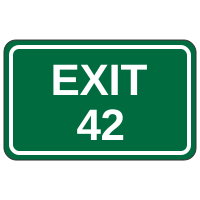
You see a green sign like this, but you miss your exit. What should you do?
Answer: Continue to the next exit and return from there
Never stop, back up or turn around on a highway; take the next exit and come back.
Besides protecting you in a crash, how does a seat belt help the driver?
Answer: It keeps you in position to control the car
A seat belt keeps you in your seat during sudden stops and turns, so you can keep control of the vehicle.
Where should you never let your car's engine run?
Answer: In a closed garage
Exhaust fumes build up quickly in a closed space and can cause carbon monoxide poisoning.
Bicyclists riding on the road must ride:
Answer: In the same direction as traffic
Bicyclists ride in the same direction as other traffic and follow the same rules.
A yellow diamond sign showing a truck on a downward slope means:
Answer: Steep hill ahead — check your speed and brakes
A steep downgrade is ahead. Slow down and be ready to use a lower gear.
A steady yellow traffic light means:
Answer: The light is about to turn red; be prepared to stop
A steady yellow light warns that the red light is coming. Prepare to stop.
"Braking distance" is the distance your vehicle travels:
Answer: From when the brakes are applied until the vehicle stops
Braking distance is how far the vehicle travels after you start braking until it comes to a complete stop.
A motorcyclist ahead of you moves from one side of the lane to the other. This most likely means the rider is:
Answer: Avoiding hazards or getting a better view
Motorcyclists change position in their lane to avoid potholes, debris and other hazards and to be seen. Give them the whole lane.
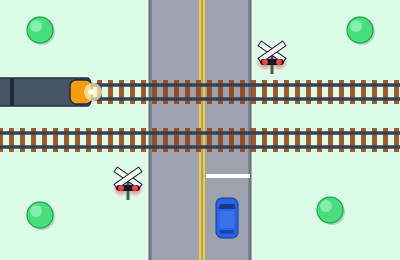
At a railroad crossing with more than one track, after a train passes you should:
Answer: Check that no second train is coming on another track
A second train may be hidden by the first. Look and listen before crossing.
Your brakes have failed and you use the parking brake. Why should you be ready to release it?
Answer: The rear wheels may lock and the car may skid
Apply the parking brake slowly and be ready to let it off if the rear wheels lock and the car starts to skid.
Your car has air bags. Should you still wear a seat belt?
Answer: Yes, air bags work together with seat belts
Air bags are a supplement to seat belts, not a replacement; always buckle up.
Your car stalls on railroad tracks and a train is coming. You should:
Answer: Get out and move away from the tracks, toward the train at an angle
Get everyone out at once. Move away from the tracks at an angle in the direction the train is coming from, so you are not hit by flying debris.
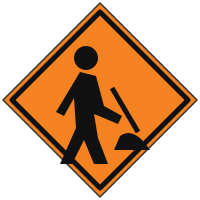
An orange diamond sign showing a person with a shovel means:
Answer: Workers are on or near the road ahead
People are working ahead; slow down and obey flaggers and work-zone signs.
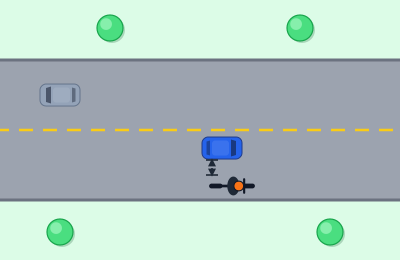
In New Jersey, when you pass a bicyclist, you must leave at least:
Answer: 4 feet
New Jersey: give bicyclists at least 4 feet of space when passing.
About this test
Questions come from the 2026 New Jersey Driver Manual and from rules that apply in every state. Each answer shows its source.
More New Jersey tests
Group 1
Start here
Full practice tests in the format of the real New Jersey knowledge test. Questions do not repeat between tests.
Group 2
Road signs
Shapes, colors and meanings of the signs on the test.
Group 3
Rules of the road
Right of way, turns, parking and sharing the road.
Group 4
Safe driving
Night, weather, emergencies, alcohol and what to do after a crash.
Group 5
New Jersey laws
Rules that are specific to New Jersey.
Group 6
Final exam prep
Check that you are ready before test day.