New Jersey DMV Practice Test 9
Practice test 9 of 9: 50 questions in the New Jersey knowledge test format, from the official handbook. Free, with explanations in 5 languages.
Loading questions…
Questions and answers in this test (50)
Open the list after you finish the test, or use it to review.
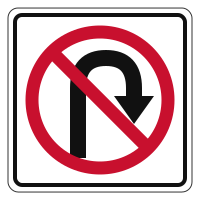
A sign showing a U-shaped arrow inside a red circle with a slash means:
Answer: No U-turn
You may not make a U-turn here.
You are turning left at an intersection on a green light. You must yield to:
Answer: Oncoming traffic going straight or turning right
A driver turning left yields to oncoming traffic going straight or turning right, and to pedestrians.
When you drive out of a driveway or parking lot onto a road, you must:
Answer: Stop and yield to traffic and pedestrians
Coming out of a driveway, alley or private road, stop and yield to pedestrians and to traffic on the road.
A steady yellow X signal is lit above the lane you are driving in. You should:
Answer: Safely move out of that lane
A steady yellow X means the lane is about to change direction or close. Move out of it as soon as you safely can.
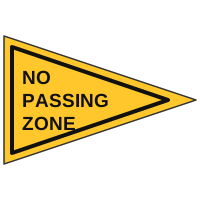
A yellow sign shaped like a sideways triangle (pennant), placed on the left side of the road, means:
Answer: No passing zone
The pennant marks the start of a no-passing zone.
Which of these is an example of aggressive driving?
Answer: Tailgating and unsafe lane changes
Aggressive driving includes speeding, following too closely, unsafe lane changes, not signaling and ignoring signs and signals.
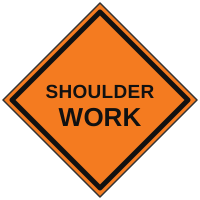
This sign means:
Answer: Workers are on the shoulder
Work is taking place on the shoulder next to the travel lanes.
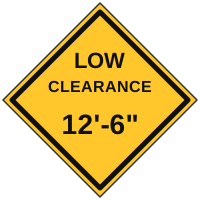
This sign means:
Answer: A low bridge or underpass is ahead
Low Clearance warns of a low bridge or overpass; the number is the maximum safe vehicle height.
In New Jersey, how is the seat belt law enforced for unbuckled back-seat passengers aged 18 or older?
Answer: They may be ticketed only if the vehicle is stopped for another reason
Under a secondary law, unbuckled back-seat occupants 18 and older may be issued a summons if the vehicle is stopped for another reason.
How can marijuana affect a driver?
Answer: It makes it harder to judge time and distance
Marijuana impairs driving. It can cause drowsiness, make it hard to judge time and distance, and make it hard to stay in your lane.
You are in the middle of an intersection when an ambulance with siren and flashing lights comes up behind you. You should:
Answer: Drive through the intersection, then pull over to the right and stop
Do not stop inside an intersection for an emergency vehicle. Clear the intersection first, then pull to the right and stop.
What is a reversible lane?
Answer: A lane where the direction of traffic changes at certain times
Reversible lanes carry traffic one way at some times (often rush hour) and the opposite way at other times. Check the signals before using one.
New Jersey's Maggie's Law makes it illegal to knowingly drive a vehicle while:
Answer: Impaired by lack of sleep
Maggie's Law (2003) makes knowingly driving while impaired by lack of sleep illegal and treats driving while fatigued as recklessness under the vehicular homicide statute.
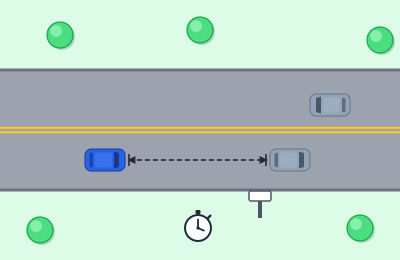
In New Jersey, the recommended minimum following distance in good conditions is at least:
Answer: 3 seconds
New Jersey: keep at least 3 seconds behind the vehicle ahead; add more in bad weather.
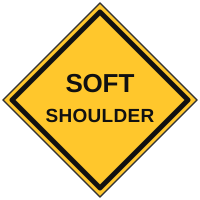
A Soft Shoulder sign is posted. If you must move onto the shoulder, you should NOT:
Answer: Brake hard, which can cause a skid
Braking hard on a soft shoulder can cause skidding or loss of control.
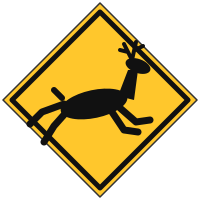
A yellow diamond sign showing a leaping deer means:
Answer: Deer often cross here — watch for animals
Deer often cross in this area, especially at dawn and dusk.
When parking downhill next to a curb, turn your front wheels:
Answer: Toward the curb
Downhill: wheels toward the curb, set the parking brake, put the car in Park (or first gear).
How many questions are on the New Jersey written permit test, and how many must you answer correctly?
Answer: 50 questions, 40 correct
New Jersey: 50 questions; you need 40 correct to pass.
On a road with two or more lanes in your direction, if you are driving slower than other traffic you should use:
Answer: The right-hand lane
Slower traffic should keep to the right-hand lane. The left lane is for passing and faster traffic.
On public roads, horseback riders and horse-drawn vehicles:
Answer: Have the same rights and duties as drivers
People riding or driving horses on public roads have the same rights as drivers and must follow the same rules of the road.
Cold and allergy medicines you buy without a prescription:
Answer: Can make you drowsy
Many over-the-counter cold, allergy and headache medicines can cause drowsiness. Check the label for warnings before you drive.
Traffic on a multi-lane road is heavy. What is the safest way to drive?
Answer: Stay in one lane and avoid weaving in and out of traffic
Weaving from lane to lane greatly raises your crash risk and rarely saves time. Keep a steady speed and change lanes only when needed.
In New Jersey, what happens to traffic fines for speeding in a highway work zone?
Answer: They can be doubled
New Jersey: fines for speeding in work zones can be doubled.
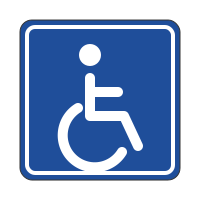
This sign means:
Answer: Access for people with disabilities
The wheelchair symbol marks access for people with disabilities.
You are driving down a street lined with parked cars, where people are walking. You should:
Answer: Slow down and be ready to stop for people stepping out
People may step out from between parked cars without warning. Slow down where pedestrians are likely and be ready to stop.
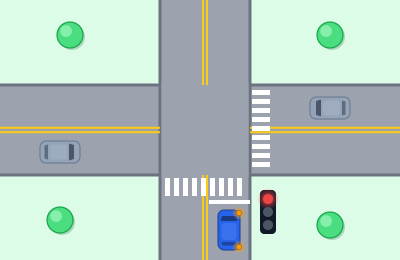
In New Jersey, may you turn right on a steady red light?
Answer: Yes, after a full stop and yielding, unless a sign prohibits it
New Jersey: right on red is allowed after a complete stop and yielding to pedestrians and traffic, unless a sign says NO TURN ON RED.
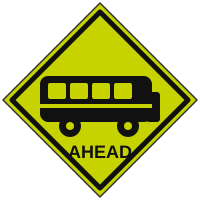
The school bus ahead is showing flashing yellow lights. This means:
Answer: The bus is about to stop; get ready
Flashing yellow lights warn that the bus is about to stop, so slow down and be prepared to stop.
On a road with several lanes going your way, the left lane is mainly for:
Answer: Drivers who are passing or turning left
The left lane is used for passing (and for left turns on streets). Slower traffic and vehicles entering or leaving use the right lane.
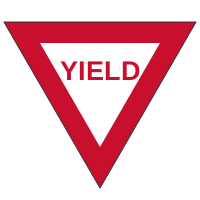
A downward-pointing triangle sign means:
Answer: Yield
The downward triangle is the YIELD sign: slow down and give the right-of-way to traffic and pedestrians.
In New Jersey, failing to stop for a pedestrian in a crosswalk can bring a fine of up to:
Answer: $500
Fines of up to $500, up to 25 days in jail, community service, a suspension of up to six months and two motor vehicle points.
Driving much more slowly than the normal flow of traffic:
Answer: Can block traffic and cause crashes
Driving far slower than other traffic blocks drivers behind you and can cause crashes. Do not drive so slowly that you hold up normal traffic.
You come up behind a farm tractor with an orange-and-red triangle on the back. You should:
Answer: Slow down early and approach with caution
The triangle marks a slow-moving vehicle. You close in on it fast, so slow down early and pass only when it is safe.
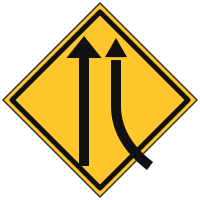
A yellow diamond sign showing two arrows side by side, the right one curving in from the side, means:
Answer: Added lane — traffic enters in its own lane, no merge needed
Entering traffic gets its own lane; it does not have to merge.
You hit a parked car and cannot find its owner. You should:
Answer: Leave a note with your name and address on the car
Try to find the owner first. If you cannot, leave a written note with your name, address and other information where the owner will find it.
In a work zone, the directions given by a flagger:
Answer: Must be followed
Flaggers control traffic in work zones. You must obey their signals.
A motorcycle is in your lane ahead. You should:
Answer: Give it the full lane, as you would a car
A motorcycle is entitled to the full width of a lane. Never share its lane.
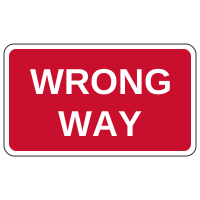
You see a red WRONG WAY sign facing you. You should:
Answer: Safely pull over or turn around — you are driving against traffic
You have entered a road or ramp the wrong way; get out of the path of oncoming traffic safely.
Railroad crossing lights have stopped flashing, but the gate is still partly down. You should:
Answer: Wait until the gate is all the way up
Do not cross until the lights and bells stop and the gates are completely up.
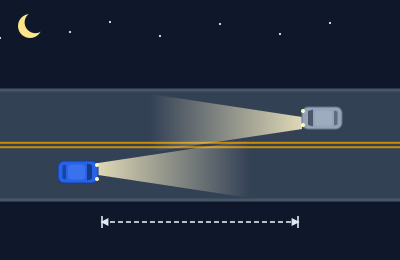
You are driving with high beams on and see a car coming toward you. You should:
Answer: Switch to low beams
Dim to low beams for oncoming traffic so you do not blind the other driver.
Double solid yellow center lines mean:
Answer: No passing; cross only to turn left into or out of a driveway or road
Double solid lines prohibit passing. You may cross them only to turn left into or out of a road or driveway.
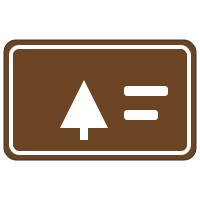
Brown signs usually point to:
Answer: Parks, recreation and cultural areas
Brown signs guide drivers to recreational and cultural points of interest.
Your car goes into deep water and is still floating. The best way out is usually:
Answer: Through an open window
Water pressure makes doors hard to open, so escape through a window while the car is still floating.
How do you begin a three-point turn (K-turn)?
Answer: From the right edge, drive forward slowly while turning the wheel sharply left
Start a three-point turn at the right edge of the road. Check traffic, then move forward slowly while turning the wheel to the left.
You want to pass a bicyclist on a narrow two-lane road, but a car is coming toward you. You should:
Answer: Slow down and wait until you can pass with plenty of room
Slow down when you come up to a bicyclist. If there is not enough room to pass safely, wait until oncoming traffic has gone by.
You are in a crash in which a person is injured. You must:
Answer: Notify the police right away
A crash with injuries must be reported to the police right away. Call 911 so police and an ambulance can come.
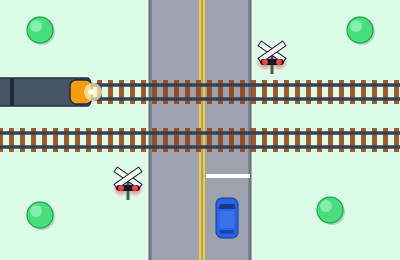
Why must drivers always yield to trains at railroad crossings?
Answer: A train cannot stop quickly
A train is very heavy and needs a long distance to stop, so it cannot stop for a car on the tracks. Always let the train go first.
If a tire blows out while you are driving, you should:
Answer: Hold the wheel tightly and slowly ease off the gas
After a blowout, hold the steering wheel firmly, ease off the gas and brake gently once the car is under control.
On a snowy or icy road, how can you find out how slippery it is?
Answer: Gently test the brakes while driving slowly
On snow or ice, test your brakes gently while moving slowly to feel how much traction you have, then adjust your speed.
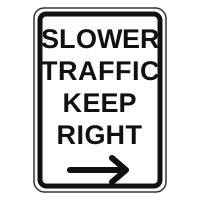
This sign means:
Answer: Drivers going slower than traffic must stay in the right lane
The sign asks slower drivers to keep right and leave the left lane for faster traffic.
In New Jersey, applicants for a basic driver license must have vision of at least:
Answer: 20/50
Basic license: 20/50 with or without corrective lenses; CDL applicants need 20/40 in both eyes.
About this test
Questions come from the 2026 New Jersey Driver Manual and from rules that apply in every state. Each answer shows its source.
More New Jersey tests
Group 1
Start here
Full practice tests in the format of the real New Jersey knowledge test. Questions do not repeat between tests.
Group 2
Road signs
Shapes, colors and meanings of the signs on the test.
Group 3
Rules of the road
Right of way, turns, parking and sharing the road.
Group 4
Safe driving
Night, weather, emergencies, alcohol and what to do after a crash.
Group 5
New Jersey laws
Rules that are specific to New Jersey.
Group 6
Final exam prep
Check that you are ready before test day.